Introduction
Transporting a mini excavator safely requires more than attaching a trailer to a truck and driving to the next job site.
Contractors, landscaping businesses, rental companies, and equipment dealers must consider machine weight, trailer capacity, towing limits, loading equipment, transportation dimensions, and cargo securement.
Choosing the wrong trailer or overlooking an important weight rating can create serious safety risks and damage expensive machinery.
Before transporting a mini excavator, you should understand five essential requirements:
- Machine operating and transport weight
- Trailer payload and gross vehicle weight rating
- Towing vehicle capacity
- Loading ramps and equipment access
- Proper tie-down and cargo securement
This guide explains what contractors should check before transporting a mini excavator between construction sites.
1. Know Your Mini Excavator’s Actual Weight
The first step is identifying the machine’s actual transportation weight.
Mini excavator weight varies depending on:
- Operating weight
- Engine configuration
- Cab or canopy
- Bucket
- Attachments
- Additional counterweights
- Optional equipment
For transportation planning, use the manufacturer’s specifications for the exact machine configuration.
Do not assume that the advertised base operating weight includes every attachment or accessory.
For example, if you transport a mini excavator with an additional bucket, hydraulic attachment, or other equipment, those items must be included in the total transported load.
Why Does Machine Weight Matter?
Weight affects:
- Trailer selection
- Trailer payload
- Axle loading
- Tow vehicle requirements
- Ramp capacity
- Braking performance
- Transportation regulations
An accurate weight calculation should be completed before selecting the trailer.
2. Choose a Trailer with Sufficient Capacity
A suitable equipment trailer must support the machine’s total transported weight.
Important specifications include:
GVWR (Gross Vehicle Weight Rating): The maximum permitted loaded weight of the trailer according to its manufacturer.
Empty Trailer Weight: The weight of the trailer without cargo.
Payload Capacity: The available cargo capacity.
A basic calculation is:
Payload Capacity = Trailer GVWR – Empty Trailer Weight
For example, if a trailer has a GVWR of 10,000 lb and an empty weight of 2,500 lb, its nominal payload capacity is 7,500 lb.
However, the actual allowable load may be lower because of axle, tire, deck, ramp, and load-distribution limitations.
Always verify the manufacturer’s ratings.
3. Check Your Tow Vehicle’s Towing Capacity
The trailer itself is only one part of the transportation system.
Your truck or towing vehicle must also be suitable for the fully loaded trailer.
Check:
- Maximum towing capacity
- Gross Combined Weight Rating (GCWR)
- Vehicle GVWR
- Rear axle rating
- Hitch capacity
- Tongue weight limits
- Braking equipment
The GCWR represents the maximum permitted combined weight of the towing vehicle and trailer combination.
Passengers, tools, accessories, and other cargo can affect the available towing capacity.
Consult your vehicle owner’s manual and manufacturer towing information before transporting heavy equipment.
4. Select the Right Loading Equipment
Mini excavators are commonly transported using equipment trailers with loading ramps, folding ramps, or tilt-deck systems.
The loading arrangement should match:
- Machine weight
- Track width
- Ground clearance
- Ramp capacity
- Loading angle
- Trailer deck height
The ramps must be rated for the actual loading conditions.
A ramp that is physically wide enough is not necessarily strong enough to support the machine.
5. Prepare the Job Site Before Loading
Loading and unloading should take place on a suitable, stable surface.
Before loading:
- Park the trailer on firm, level ground.
- Connect and secure the trailer to the towing vehicle.
- Apply the required parking brakes.
- Inspect the ramps.
- Confirm the ramp connections are secure.
- Keep unauthorized people away from the loading area.
- Use a trained spotter where appropriate.
The U.S. Occupational Safety and Health Administration provides equipment transportation guidance emphasizing stable trailer positioning, suitable loading procedures, and load securement.
Reference: OSHA Equipment Transportation Guidance.
6. Understand Mini Excavator Cargo Securement
Once the excavator is on the trailer, it must be restrained against movement during transportation.
Common securement equipment includes:
- Rated chains
- Appropriate binders
- Designated machine tie-down points
- Trailer anchor points
- Chocks or other suitable blocking devices
The securement system must be suitable for the machine weight and transportation conditions.
In the United States, FMCSA cargo securement regulations apply to covered commercial motor vehicles operating in interstate commerce.
Under 49 CFR 393.130, heavy tracked or wheeled equipment weighing 10,000 lb or more must be secured against lateral, forward, rearward, and vertical movement using at least four tiedowns. The regulation also requires accessory equipment to be lowered and secured.
Lighter equipment may be secured under the heavy-equipment rule or the applicable general securement requirements.
Regulations differ between jurisdictions, so contractors should confirm the rules applicable to their transportation operation.
Reference: FMCSA Cargo Securement Rules.
7. Check Transportation Height and Width
Transportation dimensions matter when traveling on public roads.
Measure the complete loaded configuration, including:
- Machine height
- Trailer deck height
- Overall width
- Total loaded length
- Attachments
- Other transported equipment
Check local restrictions concerning:
- Maximum transport height
- Maximum width
- Vehicle length
- Weight limits
- Oversize permits
Do not assume that a compact excavator is automatically exempt from transportation restrictions.
8. Complete a Pre-Transport Inspection
Before leaving the job site, inspect:
| Inspection Item | What to Check |
|---|---|
| Machine weight | Correct configuration and load |
| Trailer | GVWR and condition |
| Tires | Pressure and load rating |
| Hitch | Proper connection |
| Brakes | Working condition |
| Ramps | Correct rating and secure connection |
| Chains | Correct working load limit |
| Tie-down points | No damage or deformation |
| Attachments | Lowered and secured |
| Lights | Working correctly |
| Transport height | Within applicable limits |
After starting the journey, follow applicable inspection requirements and recheck the load at suitable stopping points.
9. Why Transport Planning Matters for Equipment Businesses
Transportation is an important part of equipment ownership and dealership operations.
Contractors need to move machines between projects.
Rental companies need reliable delivery and collection arrangements.
Equipment dealers need to deliver machines to customers.
A clear transportation plan can help reduce delays, avoid equipment damage, and improve customer service.
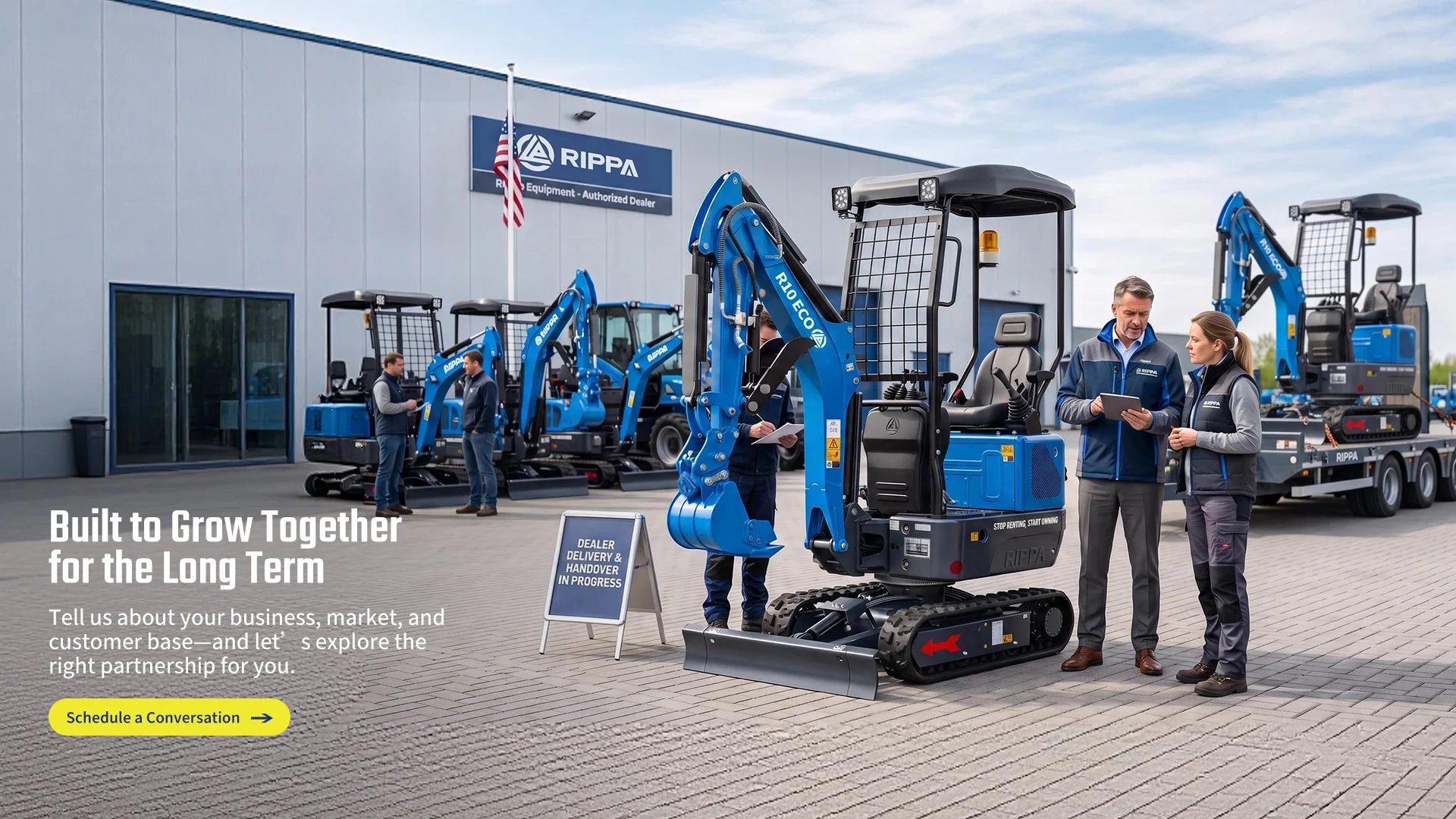
For businesses purchasing mini excavators from manufacturers, it is also important to confirm the machine’s shipping dimensions, weight, and export packaging requirements before ordering.
RIPPA offers compact excavator models for different commercial applications. Dealers and importers should request current model-specific weight and dimensional documentation when planning transportation or international shipping.
Frequently Asked Questions
What do I need to transport a mini excavator?
You need a suitably rated trailer, compatible towing vehicle, appropriate loading equipment, and a securement system that meets the applicable regulations.
Can a pickup truck tow a mini excavator?
Some pickup trucks can tow certain compact excavator configurations, but the actual combination must remain within all vehicle, hitch, trailer, axle, and tire ratings.
Do mini excavators need to be tied down?
Yes. They must be properly restrained during transportation according to applicable cargo securement requirements and manufacturer instructions.
Can I transport an excavator with its bucket attached?
This depends on the machine, transport configuration, and manufacturer instructions. The attachment must be positioned and secured appropriately.
How often should I inspect a transported excavator load?
Inspect it before departure and at the intervals required by applicable regulations and operating procedures.
Conclusion
Understanding mini excavator transport requirements is essential for contractors, rental companies, and equipment dealers.
Before moving a machine, confirm its weight, trailer capacity, towing limits, loading ramp ratings, transportation dimensions, and cargo securement.
A properly planned transportation system protects the machine, the towing vehicle, and other road users.
For equipment businesses, transportation capability is also an important part of providing professional machinery sales and rental services.
 Home
 Products
 Email
 WhatsApp

