A successful dealership should not depend on one profitable order.
It needs a business model capable of producing sustainable returns over time.
For this reason, RIPPA’s dealer strategy includes two additional pillars: profit support and digital support.
One provides incentives for dealers who build the market correctly.
The other provides the operating tools needed to manage that business more efficiently.
Profit Support: Rewarding Strong Dealer Performance

RIPPA’s planned dealer management system introduces performance-based dealer levels.
Dealer performance can be evaluated across multiple areas, including sales, service, parts, marketing activities and compliance with dealer policies.
Higher-performing dealers can qualify for stronger incentives.
Under the current strategy, total rebates can reach up to 10%, depending on dealer level and performance.
The idea is not simply to reward volume.
A healthy equipment business also depends on after-sales capability.
For this reason, parts purchasing and service performance are part of the rebate system.
Dealers that maintain appropriate parts capability, respond effectively to customer service needs and meet operational standards can be rewarded accordingly.
Marketing activity can also contribute to dealer development. Investments in showrooms, exhibitions and local promotion may therefore be incorporated into dealer incentive policies.
At the same time, violations such as unauthorized cross-territory selling, MAP violations or failure to fulfill service responsibilities can affect dealer evaluation and rebates.
This creates an important principle:
higher rewards should come from stronger overall dealer performance—not sales volume alone.
Digital Support: Managing the Business With Data
As a dealer network grows, manual communication becomes increasingly inefficient.
Sales teams ask where an order is. Service teams ask whether a part has shipped. Finance teams need records. Dealers need warranty information. The factory needs to understand sales territories and inventory.
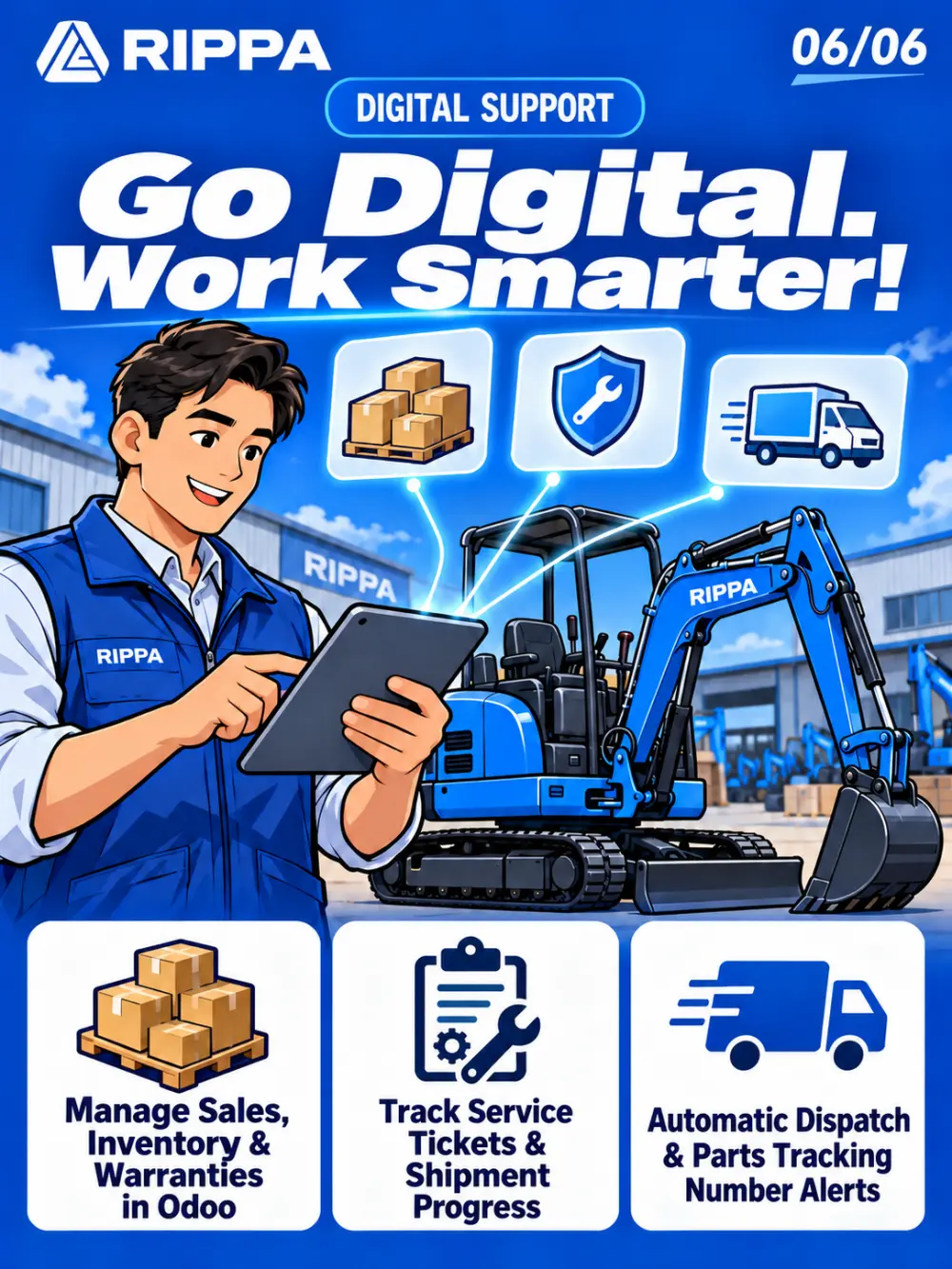
RIPPA is therefore expanding the use of Odoo as the digital infrastructure connecting dealers and the factory.
The system is intended to support areas such as:
- machine serial-number registration;
- customer and sales records;
- warranty management;
- repair history;
- machine and parts inventory;
- service-ticket submission;
- technical-support requests;
- shipment tracking;
- parts tracking;
- dealer performance data;
- rebate management.
For example, when a machine is sold, its serial number can be linked to the dealer, customer, market and sales date.
When a service case occurs, the history can be recorded instead of being scattered across emails and messages.
When parts are shipped, tracking information can be connected to the process.
Z Dealer Relationship to Dealer Operating System
The goal of digitalization is not to add unnecessary administration.
It is to reduce manual communication and make important information visible and traceable.
For dealers, that means fewer disconnected conversations and more structured management.
For the manufacturer, it means better visibility into how the dealer network is operating.
And for customers, it should ultimately contribute to faster and more consistent service.
RIPPA’s dealer strategy therefore connects profitability with operational discipline.
Dealers that sell well, service customers well and manage their market professionally should have more opportunities to grow and earn.
 Home
Home
 Produkty
 E-mail
 WhatsApp

