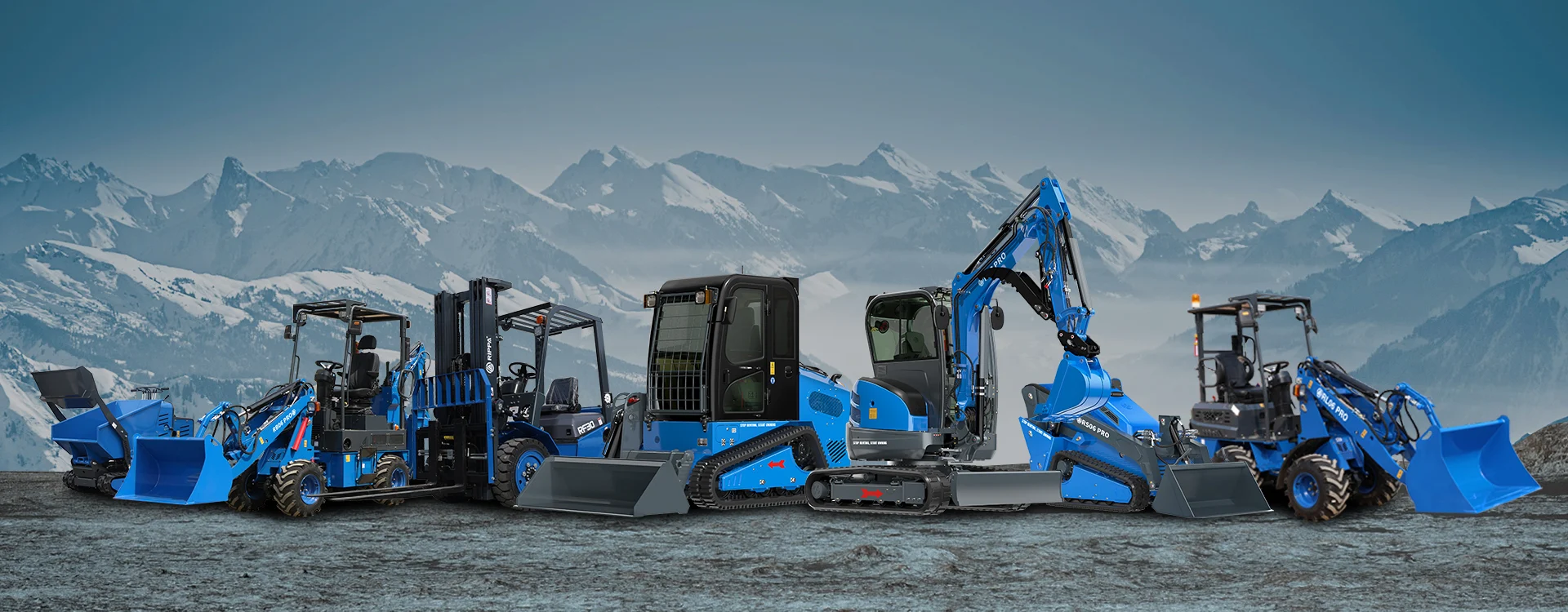
When you’re choosing between pale compatte e compact track loaders (CTLs), it’s not a matter of which is universally better — it’s about which fits your job, terrain, budget, and usage pattern best. In this guide, I’ll break down the differences, advantages, disadvantages, and selection tips so you can make an informed decision that aligns with your project needs.
1. What Is a Skid Steer Loader?
A pala compatta is a compact, wheel-driven machine often used for digging, lifting, loading, and material handling. Because each side’s wheels can turn independently (or one side can skid relative to the other), it can pivot sharply, making it ideal for tight spaces and urban sites.
Key Advantages of Skid Steer Loaders:
-
Excellent maneuverability in confined job sites
-
Faster travel speed on hard surfaces (concrete, asphalt, compacted soil)
-
Lower initial cost compared to tracked machines
-
Simpler maintenance (wheels vs. tracks)
But skid steers also have trade-offs (which we’ll compare next against CTLs).
2. What Is a Compact Track Loader (CTL)?
A pala gommata compatta is essentially a skid steer design, but replacing wheels with rubber tracks. This changes how the machine interacts with the ground.
Key Characteristics of CTLs:
-
Better traction and grip on soft, muddy, or uneven terrain
-
Superior flotation—less ground pressure, so less sinking or damage to soft ground
-
More stability on slopes and uneven surfaces
-
Often heavier and more expensive, and track components can require more maintenance
3. Skid Steer vs. CTL: Side-by-Side Comparison
Here’s a side-by-side look at how skid steer loaders and CTLs compare across several critical factors:
| Feature | Pala gommata | Compact Track Loader (CTL) |
|---|---|---|
| Best Terrain | Hard, firm surfaces: asphalt, concrete, compacted soil | Soft, loose, muddy, sandy, or uneven ground |
| Traction & Grip | Solid on firm ground; may slip on loose surfaces | Excellent grip and stability on soft/uneven surfaces |
| Flotation & Ground Pressure | Higher pressure, more likely to sink on soft ground | Lower pressure, spreads weight more evenly |
| Maneuverability in Tight Spots | Very nimble, can pivot easily in narrow areas | Slightly less tight turning radius due to tracks |
| Cost (Purchase / Initial) | Generally lower cost | Higher cost due to track system |
| Maintenance / Operating Cost | Wheels are simpler; tires last long | Tracks and undercarriage require more upkeep |
| Speed / Efficiency | Faster on hard surfaces | Slower, but more consistent on tough terrain |
| Durability on Harsh Terrain | Tires vulnerable to punctures, slipping | Tracks more durable under tough, rugged conditions |
In short: skid steer loaders shine where the ground is stable and the site is tight; CTLs shine when ground conditions are challenging or inconsistent.
4. When to Choose a Skid Steer Loader
Here are situations where a skid steer loader is likely the better option:
-
Your work site mostly has superfici dure like pavement, concrete, or compacted soil.
-
Maneuverability in tight spaces, narrow alleys, or crowded sites is crucial.
-
Your budget is constrained and you want lower upfront costs.
-
Maintenance simplicity is desirable — changing tires is easier than dealing with track parts.
-
The ground conditions are generally consistent and not muddy or soft.
5. When a Compact Track Loader Is the Better Option
You might lean toward a CTL if:
-
You frequently work on muddy, sandy, soft, or uneven ground.
-
You need more stability on slopes, embankments, or uneven terrain.
-
You want to minimize soil disturbance or surface damage in sensitive environments.
-
Durability and traction in challenging conditions are more critical than top speed on firm surfaces.
6. Cost Considerations
While cost shouldn’t be the sole deciding factor, it plays a big role in many real-world decisions:
-
Initial purchase cost: CTLs are generally more expensive because of the track systems and reinforced undercarriage.
-
Maintenance & parts: Tracks, rollers, and undercarriage components tend to wear and may require more frequent replacement than tires.
-
Fuel efficiency: On hard surfaces, skid steers tend to be more fuel efficient; on soft terrain, CTLs might save time (and thus operating cost) by not getting stuck or bogged down.
-
Longevity in context: If your application is mostly on hard, stable terrain, a skid steer might last longer without major overhauls. On rough terrain, a CTL may endure more reliably over time.
7. Selecting the Right Machine for Your Needs
To decide between a skid steer loader and a CTL, assess these factors carefully:
-
Primary terrain & ground conditions you’ll be working on
-
Slope and grade conditions on job sites
-
Frequency of moving across varying ground types
-
Maneuverability vs. traction trade-off
-
Budget (initial + maintenance)
-
Compatibilità degli allegati (most attachments are compatible, but check hydraulic flow, coupler systems, etc.)
-
Resale value and brand support in your region
If your jobsite is mixed — sometimes hard surfaces, sometimes soft — it may be worth considering which machine gives you the most versatility.
8. Tips to Maximize Performance & Longevity
No matter which machine you choose, here are best practices:
-
Keep undercarriage / tires well maintained — clean debris, inspect wear, adjust tension (for tracks).
-
Scegli appropriate tire or track types (e.g. turf tires, heavy-duty tracks) depending on your environment.
-
Monitor hydraulic system carefully—change filters and fluid on schedule.
-
Use compatible attachments and ensure auxiliary hydraulics match the demands.
-
Train operators to understand machine limits — avoid overloading, side slopes, or abrupt maneuvers.
-
Store equipment properly (under cover, off wet ground) to extend life of rubber, seals, and components.
9. Conclusion: No One-Size-Fits-All Answer
The decision between a skid steer loader and a compact track loader isn’t about one being absolutely better — it’s about matching the machine to your job’s demands.
Choose a skid steer loader when:
-
You mostly work on hard, stable surfaces
-
You need maximum maneuverability in tight spaces
-
You want lower upfront cost and simpler maintenance
Choose a compact track loader when:
-
Your job involves soft, muddy, uneven terrain
-
You need extra traction, stability, and ground flotation
-
The extra cost and maintenance requirements are justified by better performance in challenging environments
 Casa
Casa
 Prodotti
 Email
Email
 WhatsApp

