Direct Answer
Before stocking RIPPA mini excavators, equipment dealers should evaluate local customer demand, target applications, machine size, transport requirements, attachment compatibility, spare parts support, maintenance information, technical support, warranty procedures, documentation, delivery arrangements, and expected inventory turnover.
The goal should not be to stock every available excavator model.
A better approach is to identify which machines fit the dealer’s main customers, such as:
- Construction contractors
- Utleieselskaper
- Landscaping businesses
- Farm equipment customers
- Fence contractors
- Rural service businesses
- Property maintenance companies
- Machinery resellers
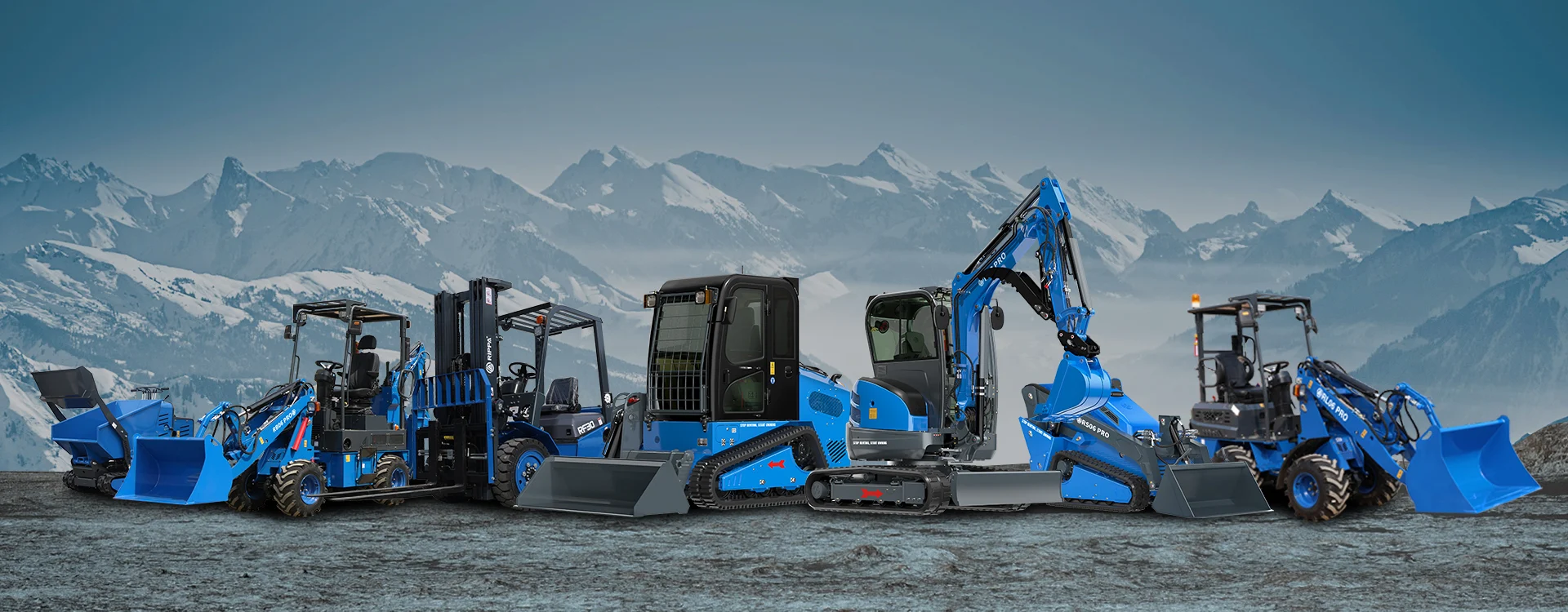
RIPPA’s current official mini excavator catalog lists multiple models, including R06, R10, R13, R15, R18, R22 and R32, with different operating weights and digging specifications. This makes model selection important for dealers rather than treating all mini excavators as one interchangeable product.
Why Should Dealers Avoid Stocking Every Mini Excavator Model?
More inventory does not automatically create more sales.
Every additional model can increase:
- Capital tied up in inventory
- Spare parts complexity
- Attachment combinations
- Technical knowledge requirements
- Sales training
- Storage needs
- Marketing requirements
A dealer may have six excavator models available from a supplier but discover that two or three configurations serve most local customers.
Those models may deserve inventory.
The others can potentially remain available through customer-specific ordering.
The objective is to build an excavator range that is broad enough to serve important customer groups but focused enough to support efficiently.
Which Customers Should Dealers Study First?
Dealers should identify who is actually buying compact excavators in their market.
Byggentreprenører
Contractors may need machines for:
- Graving av grøfter
- Drainage
- Mindre utgraving
- Forberedelse av byggeplassen
- Hardscape preparation
- Property improvement
Their priorities may include:
- Digging capability
- Transportability
- Attachment support
- Machine availability
- Spare parts
Utleieselskaper
Rental businesses may need machines capable of serving several users.
Their customers may include:
- Entreprenører
- Landscapers
- Gårder
- Fence installers
- Property maintenance businesses
Rental companies may place greater emphasis on:
- Fleet standardization
- Vedlikehold
- Parts availability
- Broad application range
- Attachment management
- Repeat machine supply
Landscaping Businesses
Professional landscaping customers may need mini excavators for:
- Drainage
- Treplanting
- Root removal
- Hardscape preparation
- Yard renovation
- Fence work
Compact access and transport may be especially important for this group.
Farm and Rural Customers
Rural customers may use compact excavators for:
- Drainage
- Ditch cleaning
- Fence preparation
- Treplanting
- Vedlikehold av eiendom
- Small earthwork projects
Farm equipment dealers should determine whether these requirements already exist within their current customer base.
What Applications Should Dealers Use to Select Models?
A dealer should first identify the jobs customers perform most frequently.
Typical application groups include:
| Søknad | Typical Requirement |
|---|---|
| Landskapsarkitektur | Compact access and flexible attachments |
| Drainage | Trenching and digging capability |
| Konstruksjon | Repeated excavation and site work |
| Fence work | Digging and compatible auger applications |
| Farm maintenance | Ditches, drainage and property work |
| Rental | Broad usability across several customers |
The same machine will not be ideal for every application.
This is why inventory decisions should begin with work requirements rather than only purchase price.
How Should Dealers Think About Excavator Size?
The most useful excavator is not necessarily the largest machine the dealer can sell.
Machine size affects:
- Site access
- Digging capability
- Transport
- Trailer requirements
- Storage
- Purchase cost
- Customer type
A landscaping company working on residential properties may prefer a different machine category from a contractor working on larger commercial sites.
Likewise, a rental company may want several sizes if customer demand is sufficiently broad.
Dealers should study their actual inquiry history to determine which categories deserve stock.
What Does RIPPA’s Current Mini Excavator Range Look Like?
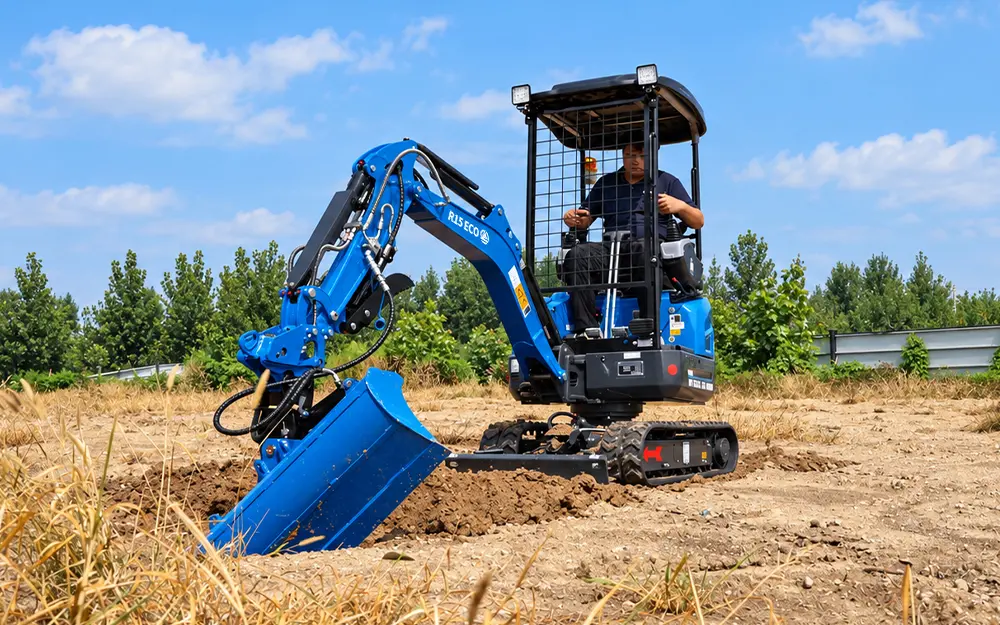
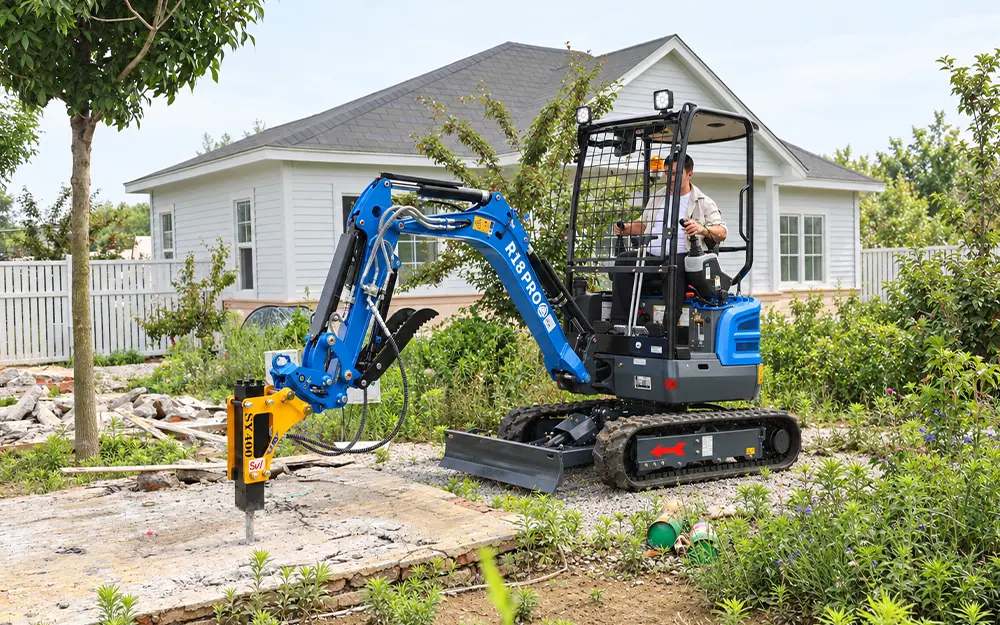
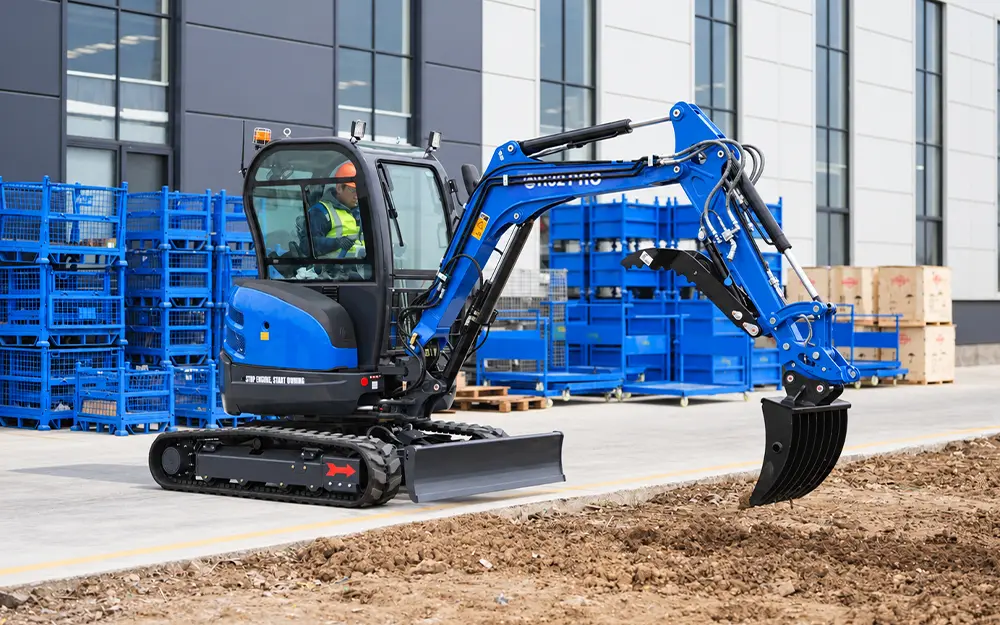
RIPPA’s current official mini excavator page includes models across several compact weight classes. For example, the page lists the R06 at 739 kg operating weight, R10 at 1,142 kg, R13 at 1,323 kg, R15 at 1,532 kg, R18 at 1,933 kg, R22 at 2,539 kg and R32 at 3,623 kg. Current specifications should always be confirmed for the exact configuration being ordered.
For dealers, this type of range makes segmentation possible.
Rather than asking:
“Which RIPPA excavator should we sell?”
ask:
“Which customer group should this machine serve?”
Should Dealers Stock the Smallest Excavator Because It Costs Less?
Not automatically.
Smaller machines may appeal to customers who prioritize:
- Compact access
- Transportability
- Smaller jobs
- Lower entry cost
But a larger commercial contractor may need greater capability.
The right inventory decision depends on:
- Customer applications
- Qualified inquiry volume
- Actual conversion
- Local transport conditions
- Dealer positioning
A low-cost machine that attracts many price-only inquiries may not necessarily be the strongest B2B inventory choice.
Why Should Dealers Analyze Lead Quality?
Suppose Model A receives 100 inquiries.
Most are individual buyers asking only:
“What is the cheapest price?”
Model B receives 25 inquiries.
But those inquiries include:
- Utleieselskaper
- Entreprenører
- Equipment resellers
- Landskapsarkitektfirmaer
Model B may have greater B2B value even though its inquiry volume is lower.
Dealers should therefore evaluate:
- Inquiry volume
- Buyer type
- Quotation rate
- Conversion
- Repeat-order potential
- Average inventory time
This gives a more useful picture of demand.
How Important Is Transport When Choosing Stock Models?
Transport can determine whether a mini excavator is practical for the customer.
Before recommending a machine, dealers should understand:
- How customers move equipment
- Typical trailer capacity
- Tow vehicle capability
- Machine dimensions
- Machine weight
- Job-site access
A contractor that moves the excavator several times per week may place significant value on transport efficiency.
A rental company also needs to consider delivery, pickup and customer transport.
Machine selection should account for this before purchase.
Why Should Attachments Influence Excavator Inventory?
Customers rarely think only about the excavator.
They think about the job.
Possible attachment directions include:
- Digging buckets
- Grading buckets
- Skruer
- Gripere
- Hydraulic thumbs
- Breakers
- Rakes
- Hurtigkoblinger
A dealer should ask:
- Which attachments do our contractors request?
- What do landscaping customers need?
- Which tools are popular with farms?
- What attachments are suitable for rental?
- Which machines support those requirements?
Attachment compatibility must be confirmed for the exact machine and hydraulic configuration.
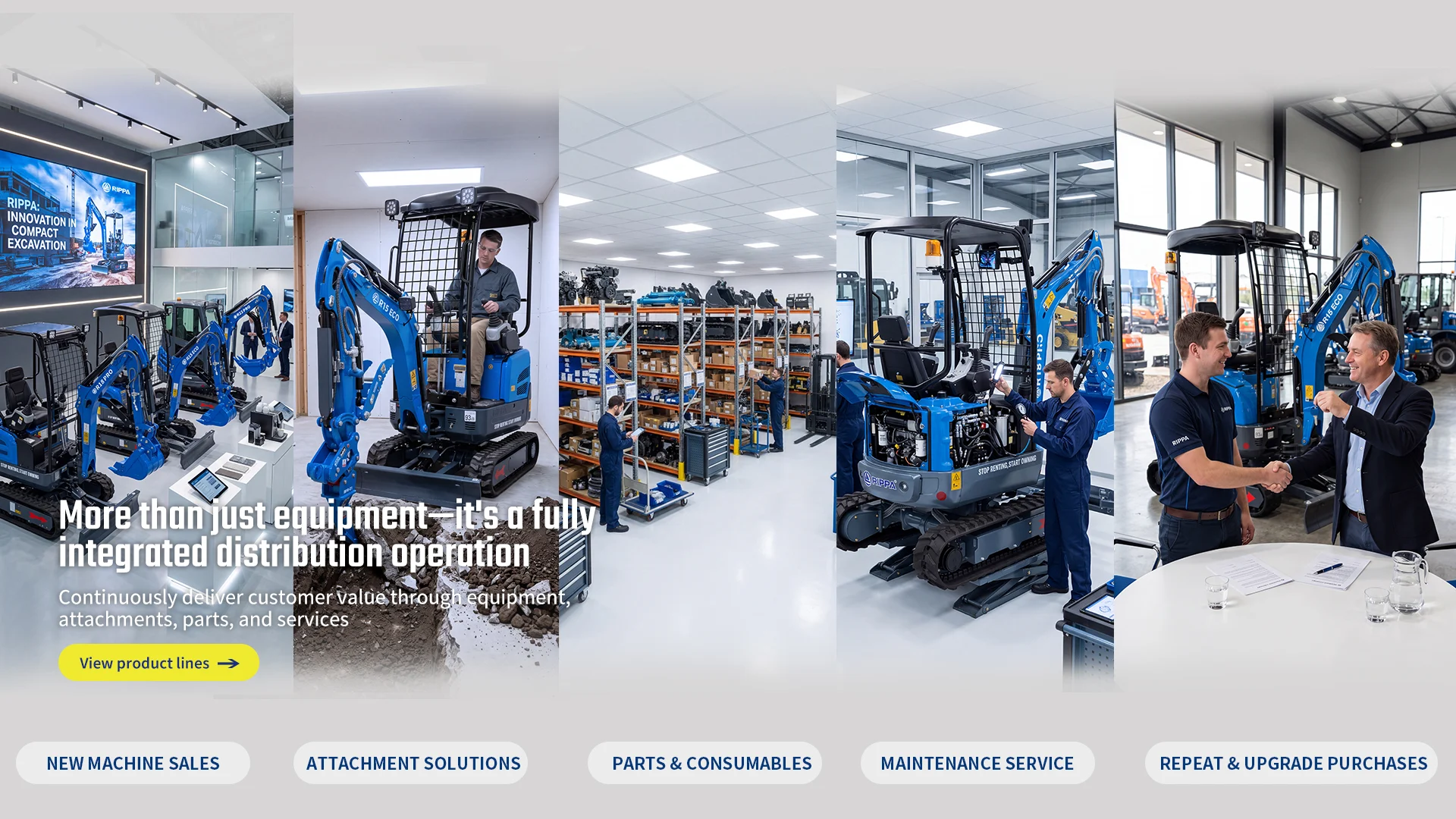
Should Dealers Standardize Around Fewer Excavator Models?
In many cases, some standardization can be useful.
A focused lineup may simplify:
- Spare parts
- Technician familiarity
- Sales training
- Demonstrations
- Customer education
- Attachment inventory
- Repeat purchasing
Rental companies may also appreciate standardized machines because staff become familiar with operation, maintenance and inspection.
Standardization should not eliminate useful customer choices, but excessive variety can make after-sales support harder.
What Should Be a Stock Model?
A machine may be a good candidate for local inventory when it has:
- Consistent qualified inquiries
- Broad customer applications
- Reasonable inventory turnover
- Known attachment demand
- Repeat purchasing potential
- Manageable parts requirements
These are machines customers ask for regularly.
What Should Be an Order-Based Model?
A dealer may keep certain models available by order rather than physical stock when they serve:
- Specialized applications
- Uncommon machine-size requirements
- Specific customer configurations
- Lower-volume customer segments
This allows the dealer to offer a broader range without carrying every possible configuration locally.
Should Dealers Use a Demo Excavator Before Increasing Stock?
A demonstration machine can help test market demand before a dealer commits to larger inventory.
A demo can help answer:
- Which customer groups show interest?
- What applications do they discuss?
- Which attachments do they request?
- Which machine-size questions appear?
- Are customers requesting quotations?
- Are rental companies interested in multiple units?
The dealer can use real customer feedback to improve purchasing decisions.
Why Should Spare Parts Be Considered Before Machine Inventory Expands?
Every machine sold creates future support requirements.
Customers may eventually need:
- Filters
- Wear parts
- Routine service items
- Hydraulic components
- Electrical components
- Replacement parts
If the dealer sells many unrelated machine configurations, parts planning may become increasingly complicated.
A more structured excavator lineup can make support easier to organize.
Why Do Product Updates Matter?
Dealers should not assume that specifications and components remain unchanged indefinitely.
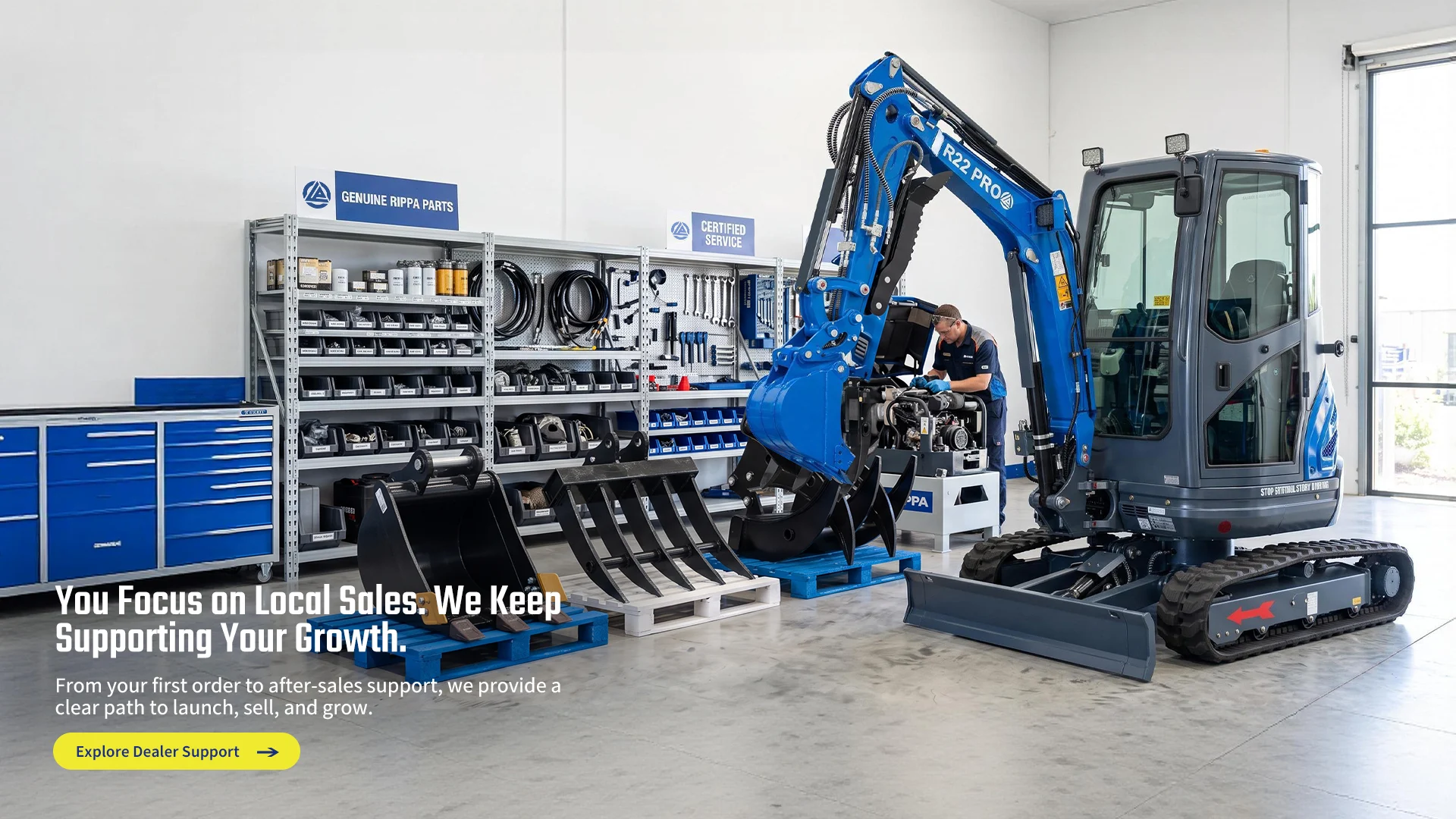
RIPPA’s official Product & Technology Updates section, for example, currently includes 2026 notices concerning changes to specific models such as the R10 and other machines.
This means dealers should maintain accurate machine identification and current product information.
A parts or attachment recommendation should be based on the actual machine configuration rather than an old brochure.
What Should Dealers Confirm Before Ordering?
A useful purchasing checklist includes:
| Area | Dealer Question |
|---|---|
| Customer | Who will buy this model? |
| Søknad | What work will it perform? |
| Modell | Is the size appropriate? |
| Transport | Can customers move it efficiently? |
| Vedlegg | What compatible tools are available? |
| Parts | How will the machine be supported? |
| Vedlikehold | What routine service is required? |
| Teknisk støtte | How are technical questions handled? |
| Garanti | What are the current terms? |
| Documentation | What current information is provided? |
| Inventory | How quickly is the model expected to sell? |
| Reordering | Can additional units be supplied? |
How Can Dealers Build a Three-Level Excavator Strategy?
Depending on local demand, a dealer might organize products into three broad roles.
Entry / Compact Category
For customers prioritizing:
- Tight access
- Smaller projects
- Transport convenience
Core Commercial Category
For customers with:
- Repeated excavation work
- Landskapsprosjekter
- Contractor applications
- Rental demand
Higher-Capability Compact Category
For customers needing:
- More substantial excavation
- Broader working capability
- Different attachment requirements
This is a market-planning framework rather than a recommendation of specific models.
The exact products should be matched to verified customer requirements.
Ofte stilte spørsmål
Which RIPPA mini excavator should dealers stock?
There is no universal model. Dealers should choose according to customer applications, machine size requirements, transport, attachment demand and local sales history.
Should dealers stock every RIPPA mini excavator?
Usually there is no need to stock every available model. Lower-volume machines can potentially be supplied according to customer orders.
Why does attachment compatibility matter?
Because customers buy excavators to perform specific work, and the required attachment may determine which machine configuration is appropriate.
Are smaller mini excavators always easier to sell?
Not necessarily. Smaller machines may serve certain customers well, while commercial contractors or rental fleets may require different capabilities.
Should parts support influence stock decisions?
Yes. The more machines a dealer sells, the more important spare parts and technical support become.
Can a dealer test demand with one machine first?
A demonstration or limited initial inventory can help the dealer collect customer feedback before expanding stock.
Sammendrag
Equipment dealers should choose RIPPA mini excavator inventory according to real B2B demand rather than trying to stock the entire product catalog.
The key factors are:
- Customer type
- Søknader
- Machine size
- Transport
- Attachment compatibility
- Qualified inquiries
- Inventory turnover
- Spare parts
- Teknisk støtte
- Repeat purchasing potential
RIPPA currently offers multiple mini excavator models across different compact size classes, giving dealers the ability to build a more targeted lineup.
For a B2B dealer, the strongest excavator inventory is not necessarily the one with the most models.
It is the one where each machine has a clear customer, a clear application and a support plan after the sale.
 Hjem
Hjem
 Produkter
 E-post
 WhatsApp

