Innledning
One of the most important questions before buying or renting a mini excavator is:
What size mini excavator do I actually need?
Choosing the correct size affects:
- Digging capability
- Job-site access
- Transport
- Productivity
- Attachment compatibility
- Purchase cost
- Driftskostnader
A smaller machine may fit through tight access points but may take longer to complete heavier excavation.
A larger compact excavator may offer greater working capability but require more transport capacity and more room to operate.
For contractors, landscapers, farms, rental companies, and equipment dealers, the correct answer is not simply “buy the biggest machine you can afford.”
The better approach is:
Choose the smallest machine that can efficiently perform the work you expect to do regularly.
How Are Mini Excavators Classified by Size?
There is no single universal naming system used in every market.
However, commercial buyers often think in broad operating-weight classes such as:
- Around 1 ton
- Around 1.5 to 2 tons
- Around 2.5 to 3 tons
- Around 3 to 4 tons
- Larger compact excavator classes
Exact operating weights vary by:
- Modell
- Cab or canopy
- Vedlegg
- Skuffe
- Additional equipment
Always use the manufacturer’s specifications for the exact machine.
What Is a 1-Ton Mini Excavator Best For?
Very small mini excavators are often considered when access is the main limitation.
Possible applications include:
- Hageanlegg for boliger
- Garden projects
- Light trenching
- Small drainage work
- Vedlikehold av eiendom
- Narrow-access excavation
Their main advantage is compactness.
Why Choose a 1-Ton-Class Machine?
A smaller excavator may be easier to use where there are:
- Narrow gates
- Houses close together
- Existing landscaping
- Restricted operating areas
It may also be easier to transport than heavier equipment, depending on the actual machine, trailer, and local requirements.
What Are the Limitations?
Smaller size generally means buyers should pay closer attention to:
- Digging capability
- Reach
- Stabilitet
- Productivity
- Attachment requirements
A very small machine can be excellent for the correct job but inefficient when repeatedly pushed into work that requires greater capability.
What Is a 1.5- to 2-Ton Mini Excavator Best For?
This class can offer a useful step up for professional landscaping and light contractor work.
Potential applications include:
- Drainage
- Graving av grøfter
- Treplanting
- Yard renovation
- Fence preparation
- Small construction
- Rural property maintenance
For some businesses, this size provides a balance between compact access and increased working capability.
Who Should Consider a 2-Ton Mini Excavator?
Potential users include:
- Professional landscapers
- Hardscape contractors
- Fence companies
- Property maintenance businesses
- Gårder
- Small rental fleets
The important issue is whether the machine’s actual:
- Digging depth
- Reach
- Weight
- Width
- Hydraulisk ytelse
match the expected jobs.
What Is a 3- to 4-Ton Mini Excavator Best For?
Larger compact excavators become attractive when businesses need stronger overall capability while still wanting a compact machine.
Potential applications include:
- Contractor excavation
- Utility preparation
- Larger drainage projects
- Commercial landscaping
- Leiebiler
- General compact construction
Construction Equipment reported in 2026 that the 3- to 4-metric-ton class is particularly popular, noting its balance of digging performance, lift capability, maneuverability, and transportability.
That does not mean every buyer should choose this class.
A residential landscaper working through narrow gates may value a smaller machine more.
1 Ton vs 2 Ton vs 3–4 Ton Mini Excavator
| Factor | Around 1 Ton | Around 2 Tons | Around 3–4 Tons |
|---|---|---|---|
| Tight access | Strong advantage | Good depending on model | More site-dependent |
| Light landscaping | Strong fit | Strong fit | May be more machine than required |
| Drainage | Light work | Broad applications | More demanding applications |
| Contractor use | Limited by job demands | Light/general work | Stronger general-commercial fit |
| Transport | Typically easier | Moderat | Requires greater transport planning |
| Kapasitet for vedlegg | Model-dependent | Broader potential | Often broader |
| Productivity | Best on suitable small jobs | Balanced | Greater capability for heavier work |
| Rental market | Niche/tight-access demand | Broad compact demand | Strong professional demand in many markets |
This is a general framework only. Always compare specific models.
What Size Mini Excavator Is Best for Landscaping?
Start with access.
Ask:
- How wide are typical gates?
- How close are homes or fences?
- How much room does the machine have to swing?
- What surfaces will the machine travel over?
Then evaluate the actual work.
Small Residential Landscaping
A smaller compact excavator may be appropriate for:
- Planting
- Light drainage
- Hageoppussing
Professional Hardscaping
A larger machine may be useful for:
- Soil excavation
- Drainage
- Retaining-wall preparation
- Larger property projects
The best landscaping excavator is therefore determined by both access and workload.
What Size Mini Excavator Is Best for Contractors?
Contractors should review their project history.
Look at the excavation performed during the last 6–12 months.
Ask:
- What depth was required?
- How much material was moved?
- Which machine sizes were rented?
- Which machine completed the work efficiently?
- What projects are expected next year?
If most work repeatedly requires more capability than a very small excavator provides, buying a larger machine may improve productivity.
However, purchasing too large can create:
- Transport problems
- Access limitations
- Higher capital requirements
What Size Is Best for a Rental Fleet?
Rental companies have a different challenge.
Their machine must fit many customers.
Review:
- Rental history
- Most requested machine sizes
- Customer industries
- Rental duration
- Lost bookings
- Attachment demand
A broad-demand machine can be more valuable than an unusual configuration that only fits a small number of users.
Rental companies may also stock multiple classes once demand is large enough.
For eksempel:
- Smaller unit for tight-access landscaping
- Mid-size unit for general users
- Larger compact unit for contractors
But fleet expansion should follow actual utilization.
What Size Mini Excavator Is Best for Farms?
Farm customers may need excavation for:
- Drainage
- Ditches
- Fence preparation
- Tree work
- Vedlikehold av eiendom
Smaller machines can be useful for lighter, frequent property work.
Larger compact excavators may be appropriate where:
- Projects are more demanding
- Greater digging capability is needed
- The machine will operate regularly
A farm should avoid choosing only around one unusually large project.
If the large project occurs once while smaller maintenance occurs every month, it may be better to own a smaller machine and rent larger equipment when necessary.
How Deep Do You Need to Dig?
Digging depth is one of the most important specification checks.
Do not assume operating weight tells you exact digging performance.
Compare the actual model specification against:
- Drainage depth
- Trench depth
- Foundation requirements
- Anvendelser innen landskapsarkitektur
You should also consider:
- Reach
- Dump height
- Bucket size
- Working conditions
Specifications should match real projects.
How Important Is Machine Width?
For residential and landscape applications, width can determine whether the machine can reach the job at all.
Before buying:
- Measure common access points.
- Compare them with the exact machine width.
- Allow appropriate clearance.
- Consider attachment and operating movement.
A powerful excavator outside the gate has zero productivity on the other side.
How Does Excavator Size Affect Transport?
Increasing machine size usually increases transportation requirements.
Commercial buyers should confirm:
- Actual operating weight
- Attachment weight
- Trailer rating
- Tow vehicle capacity
- Loading setup
- Applicable transport regulations
Do not compare the bare machine weight with trailer capacity and assume the combination is automatically suitable.
The complete transported configuration matters.
How Does Size Affect Attachments?
Attachments may include:
- Digging buckets
- Grading buckets
- Skruer
- Hydraulic thumbs
- Gripere
- Breakers
Larger attachments are not automatically compatible with larger-looking machines.
Confirm:
- Attachment weight
- Hydraulic flow
- Hydraulic pressure
- Coupler
- Machine limits
This is especially important when attachments are central to the business model.
Should You Buy a Bigger Excavator “Just in Case”?
Usually, the better question is how often the extra capability will be used.
A business that purchases more machine than it needs may face:
- Higher purchase cost
- Higher transport requirements
- Reduced access
- Additional operating expense
But an undersized machine can also cost money through:
- Slower production
- Longer jobs
- Inability to perform common work
The goal is not minimum size.
It is right size.
Should You Buy One Size or Build a Multi-Size Fleet?
A growing contractor may eventually own multiple machines.
For eksempel:
Small Machine
For:
- Tight-access residential projects
Larger Compact Machine
For:
- Kommersiell utgraving
- Higher productivity work
Rental businesses can use the same approach when customer segments justify it.
But new businesses should avoid buying several sizes before validating demand.
How Should Equipment Dealers Choose Which Sizes to Stock?
Dealers should separate:
frequently requested sizes from frequently purchased sizes.
A machine can generate many inquiries but few sales.
Track:
- Inquiry volume
- Qualified leads
- Quotes
- Sales
- Days in stock
- Customer industries
- Attachment purchases
Core sizes with strong turnover deserve more stocking consideration.
Less common sizes may be offered as special-order machines.
Why Is This Important for Dealer Capital?
Every stocked excavator represents money invested before the customer pays for it.
Too little inventory can cause dealers to lose urgent buyers.
Too much inventory can reduce cash available for:
- Parts
- Marketing
- Reorders
- Operations
- Other product categories
The goal is not maximum inventory.
It is enough inventory to capture demand without unnecessarily tying up capital.
What Mini Excavator Sizes Does RIPPA Offer?
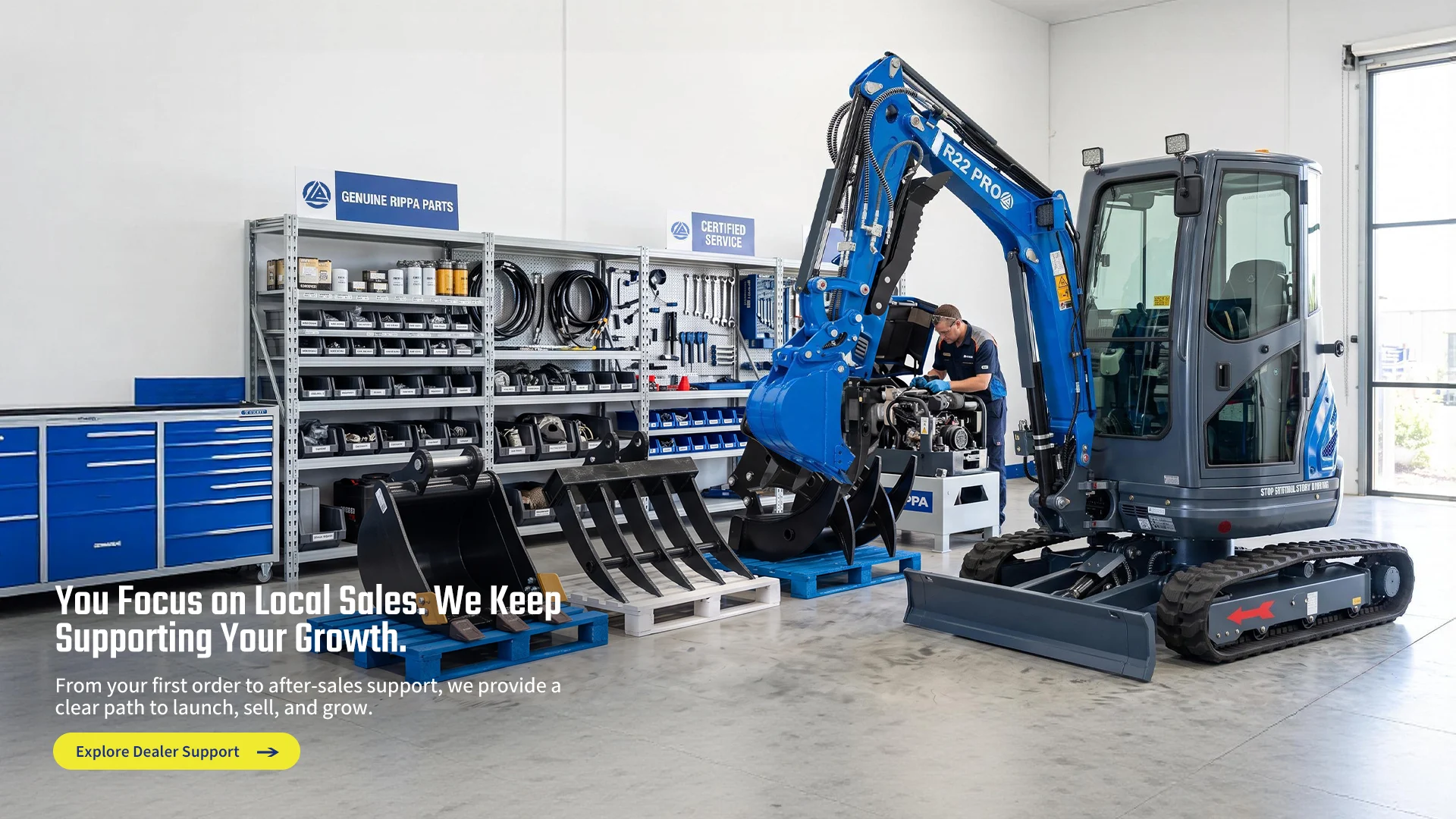
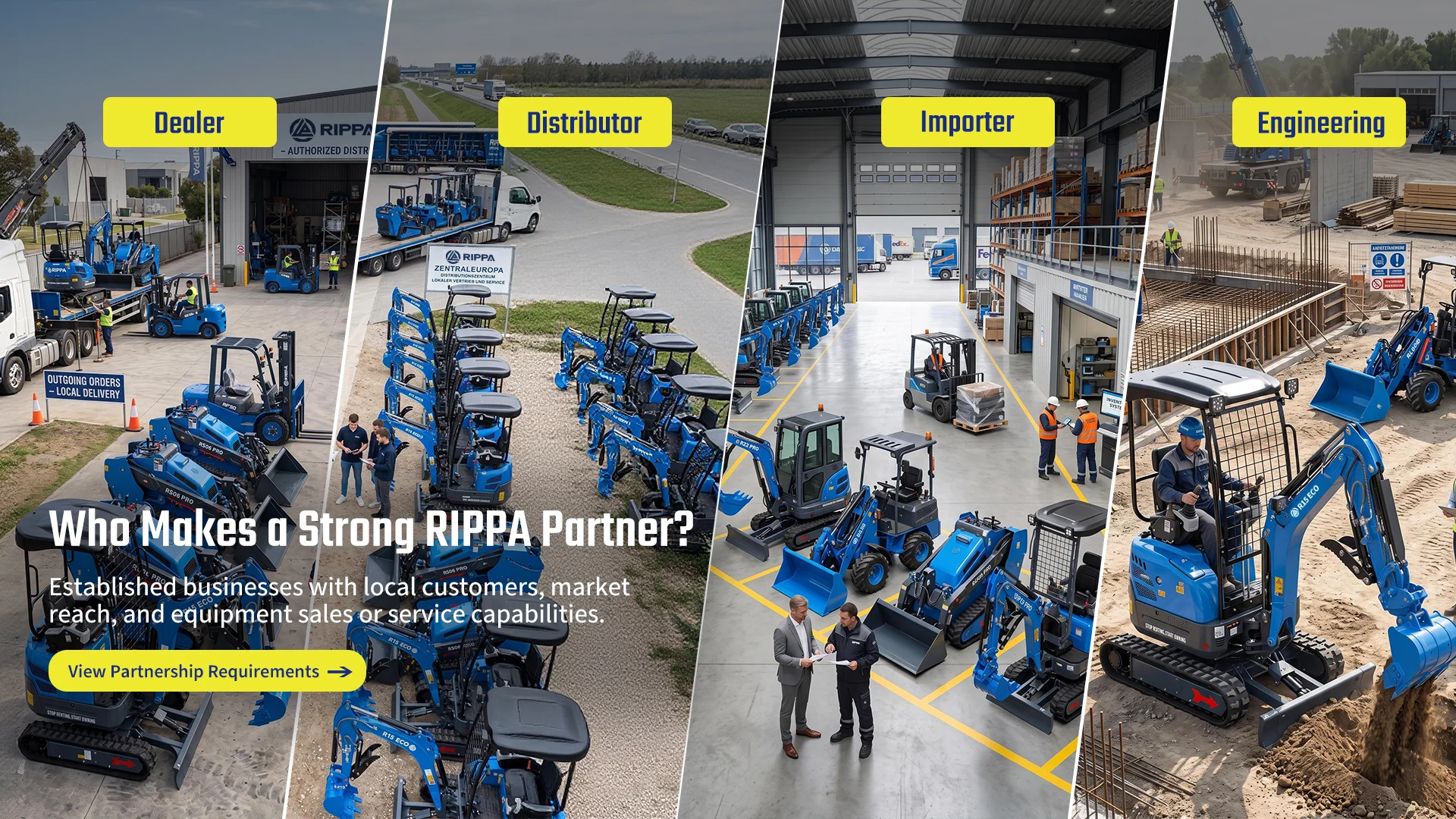
RIPPA’s current mini excavator catalog lists multiple models across compact operating-weight classes, allowing buyers and dealers to compare machines according to their applications rather than relying on one universal size.
Because specifications and configurations can change, buyers and dealers should confirm current model details directly before ordering or publishing final technical claims.
Mini Excavator Size Selection Checklist
Before buying, answer:
- What are my three most common jobs?
- What digging depth do they require?
- What access limitations exist?
- How will the machine be transported?
- What attachments will be used?
- How often will the machine operate?
- Is this for one business or multiple rental customers?
- Is parts and service support available?
If you cannot answer these questions, it may be too early to choose the machine.
Ofte stilte spørsmål
What is the best mini excavator size for homeowners?
It depends on the property, access, task, and operator requirements. Smaller machines are often evaluated for tight residential work, but exact capabilities should be checked.
What size mini excavator is best for landscaping?
Smaller and mid-size machines are commonly relevant, depending on access and the scale of drainage, planting, hardscape, and excavation work.
Is a 1-ton mini excavator big enough?
It can be for suitable light and tight-access applications, but buyers should verify digging and productivity requirements.
Is a 3-ton mini excavator better than a 2-ton excavator?
Not automatically. The 3-ton machine may offer greater capability, while the smaller machine may provide better access or easier transportation.
What size should a rental company buy?
Use local rental history and customer demand. A broad-demand size can be more valuable than a machine selected only because it has impressive specifications.
Should dealers stock every excavator size?
Usually not. Dealers can stock proven core sizes and offer specialized configurations by order.
Konklusjon
If you are asking “What size mini excavator do I need?”, start with the work rather than the machine.
Choose around:
- Digging requirements
- Access
- Transport
- Vedlegg
- Frequency of use
- Customer demand
A 1-ton-class machine may be excellent for tight-access work.
A 2-ton-class machine may offer a useful balance for professional landscaping and lighter commercial work.
A 3- to 4-ton machine may provide greater capability for contractors and rental fleets.
But there is no universal best size.
The best minigraver is the one that completes your most common profitable work efficiently without creating unnecessary access, transport, or capital problems.
 Hjem
 Produkter
 E-post
 WhatsApp

