Buying a skid steer requires more than comparing horsepower, appearance, and price. The right machine must match the job, attachments, operating environment, and long-term service requirements. These four practical tips can help contractors, rental businesses, dealers, and equipment importers make a more informed purchase.
1. Match the Skid Steer to the Worksite
Start by identifying the tasks the machine will perform most often. Material handling, grading, trenching, drilling, sweeping, and farm work can place very different demands on a skid steer.
Consider the working surface, available space, lift requirements, daily operating hours, and transport conditions. Wheeled skid steers generally perform well on firm surfaces and can offer convenient maintenance. For soft, muddy, or uneven ground, buyers may also want to compare a compact track loader because tracks can provide additional traction and lower ground pressure.
Avoid choosing a machine only because it is larger. A compact unit may be easier to transport and operate in confined areas, while a higher-capacity machine may be necessary for heavier attachments and demanding material-handling work.
2. Check Attachment and Hydraulic Compatibility
One of the main advantages of a skid steer is its ability to use multiple attachments. However, not every attachment is suitable for every machine.
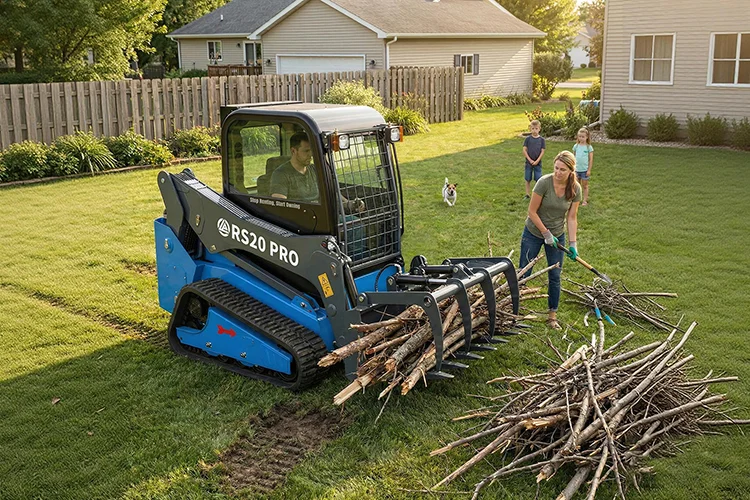
Before buying a skid steer, confirm the coupler type, hydraulic connections, required flow, operating capacity, and attachment weight. Standard buckets and pallet forks may have relatively simple requirements, while breakers, trenchers, brush cutters, and other powered tools may require specific hydraulic performance.
Ask the supplier to confirm compatibility in writing for the exact machine and attachment combination. This helps prevent poor performance, unstable operation, and unnecessary wear.
3. Calculate the Total Cost of Ownership
Purchase price is only one part of the investment. Buyers should also estimate freight, import charges, fuel consumption, routine maintenance, tires, attachments, spare parts, operator training, and possible downtime.
For dealers and rental companies, parts availability is especially important. Keeping common filters, seals, hoses, and wear components in stock can shorten repair time. Buyers should review service intervals and parts-ordering procedures before committing to a machine.
A slightly higher initial cost may be justified when the supplier offers better documentation, warranty support, and parts availability.
4. Evaluate the Supplier Before Ordering
Request a complete quotation showing the machine configuration, included attachments, optional equipment, delivery terms, warranty conditions, and estimated lead time. Model-specific specifications and compliance documents should be verified for the destination market.
RIPPA supplies skid steer loaders and attachments for contractors, equipment businesses, and international dealer partners. Buyers can discuss application requirements, wholesale orders, spare-parts planning, and available configurations before purchasing.
Buying a skid steer becomes easier when the decision is based on job fit, attachment compatibility, ownership cost, and supplier support. Compare these factors carefully, and request a configuration that reflects your actual working conditions rather than choosing on price alone.
 Головна сторінка
 Продукти
 Електронна пошта
 WhatsApp

